
I lost a career opportunity not because I wasn’t qualified, but because I was too prepared.
While I was refining my pitch, someone else submitted theirs.
While I was adding one more credential, someone else raised their hand.
While I was making sure I could justify every inch of my value, someone else assumed they already belonged.
They got the project.
At the time, I told myself I just needed to be more undeniable. More ready. But the truth was harder to admit: I had built a higher standard for myself than anyone else required.
As a first-generation Latina professional, I didn’t just carry ambition into rooms, I carried a high sense of responsibility. I knew my success reflected sacrifices made long before I stepped into a corporate office or co-founded a startup. So I told myself that average wasn’t safe, and trying without deep preparation was risky.
I believed I needed to be exceptional just to participate.
The Cultural Tension We Don’t Talk About
Many Latina professionals aren’t struggling with competence. We’re navigating cultural tension.
We were raised to value humility, but workplaces reward visibility.
We were taught not to overstep, but leadership requires assertion.
We were taught to be grateful, but negotiation requires disruption.
Upward mobility can feel layered. When you enter spaces your family never had access to, you don’t just represent yourself, you represent possibility. So we prepare. We double-check. We overthink.
Meanwhile, I began noticing something uncomfortable.
Colleagues who didn’t carry the same representational weight weren’t waiting to be perfect. They weren’t calculating how their failure might reflect on their family or community. They moved at 60-70% readiness. They experimented. They learned. They figured it out as they went.
And because they moved faster, they accumulated more opportunities. Not necessarily because they were better, but because they were decisive.
The Permission Habit
What I had developed wasn’t excellence. It was a permission habit.
I believed I needed proof before I could proceed–proof that I was ready, that I wouldn’t embarrass myself, and that I deserved to be there.
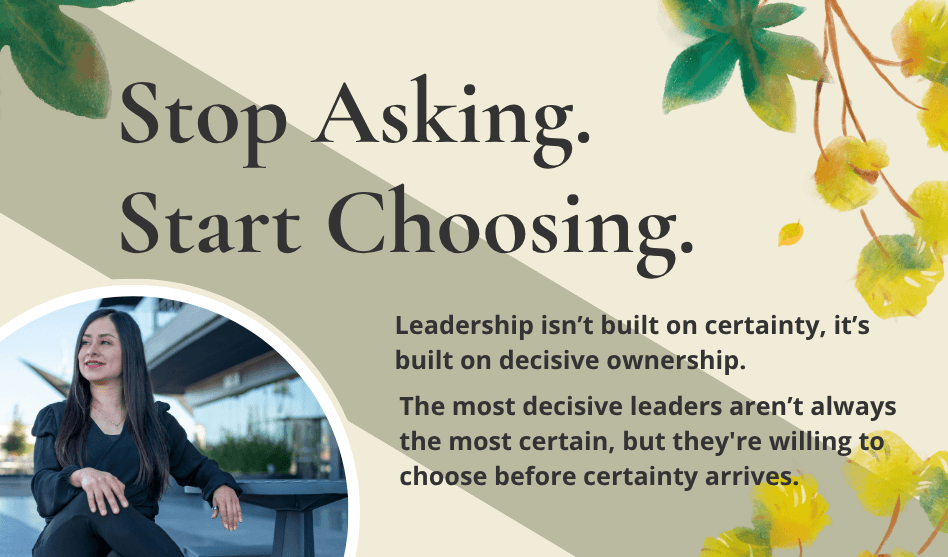
But leadership doesn’t come from proof. It comes from ownership.
As a career and executive coach, I’ve seen this pattern from emerging leaders to executives; many are waiting to feel confident before making a move. Here’s what I’ve learned: Those who rise aren’t always the most certain, but they’re often the most willing to choose before certainty arrives.
Good Enough Is Often Enough
This is the sentence I wish someone had told me earlier: “What you think is good enough is often more than good enough.”
You do not need to outperform before you participate.
You are allowed to apply when you meet most of the qualifications.
You are allowed to pitch the idea before it’s perfect.
You are allowed to negotiate what you want before you feel fearless.
The world does not reward the most prepared. It often rewards the most decisive. If we keep requiring ourselves to be exceptional just to try, we will keep watching others take imperfect action and step into opportunities we were busy over-preparing for. Ouch.
Your Move
The shift isn’t from insecure to confident. It’s from waiting to choosing.
Here’s how you can practice taking decisive action:
1. Audit Your Standard.
Are you holding yourself to excellence or to perfection? If your bar is higher than what’s actually required, that’s conditioning, not strategy.
Ask yourself: Would this level of preparation be expected from someone else in my role?
2. Separate Guilt from Growth.
For many Latina professionals, growth triggers guilt. Earning more than your family, outgrowing a role, wanting more when you were taught to be grateful.
Advancement is not abandonment.
Ask yourself: Am I hesitating because this move is wrong, or because it disrupts a familiar identity?
3. Move at 70 Percent.
Waiting for full certainty is often a disguise for hesitation. Very few meaningful career decisions come with 100% clarity.
Ask yourself: If I trusted that I could handle the outcome, would I move now?
If the answer is yes, then that’s your signal to stop waiting for perfect.
4. Make One Imperfect Move This Month.
Not five. Just one.
Apply for the role you think is a stretch.
Pitch the idea before it’s polished.
Have the conversation you’ve been rehearsing in your head.
Even if the answer is no, you will have built something more valuable than comfort—and that is evidence. Confidence is built in motion, and the more you move, the clearer things will become for you.
The next era of Latina leadership will not belong to the most prepared. It will belong to the most decisive.
You were never meant to prove your worth before claiming your place. You were meant to take it. So what is your next imperfect move?
0 Comments